Last night I went to a metal concert, my friend is in a band called Grand Master, they were launching their EP, and had a concert with three other bands at a local club. During the 3rd band, people began to mosh. While I didn't join in immediately, Grand Master's finale was my favourite song of theirs, so I joined in for the last dance.
Moshing, for those who don't know, is a form of dancing, which is pretty physical, mostly it consists of people flailing their bodies around, pushing each other and other forms of dancing/fighting.
Now, as a Mennonite I believe that peace is a consequence of the Kingdom of God, so from the outside it would seem rather disingenuous for me to participate in it, however, I would like to posit for your consideration that moshing can be theologically justified.
First of all, yes, in some contexts moshing has been known to result in physical injury, however in general, people in a moshpit are hyper-aware of their surroundings, and very careful. If people actually do fall down, people surrounding them stop moshing, and help them up. In general if you fall you aren't going to get hurt.
Secondly, Metal music has a sense of emotionality that is missing from the world around us. We live in a hedonistic utilitarian society where's people do whatever they want and try to maximize their pleasure and minimize their pain. Previously I've talked about how it is okay to be upset, even to the point of wanting to kill babies. Metal music provides a generative outlet for people to express their sorrows, pains, anger, frustration, etc, in a way that is sub-culturely acceptable. It's okay to be angry, it's okay to be depressed, the music speaks to what you are feeling in a way that isn't trivializing it.
Thirdly, people are allowed to respond to these emotions through moshing. Moshing is a physical way to express how you are feeling, if you feel the need to push somebody, to slam all of your body weight against another person, it is okay to do that, nobody takes it personal, in fact, all they are feeling the same way and will push you back.
Fourthly Moshing is voluntary. People go to a metal concert knowing that there is a strong chance that moshing is going to happen if they don't want to mosh, then there is ample space to move away from the pit and continue to enjoy the music.
As such Moshing is an active form of community building. It is a group of people gathered together, listening to the music they feel best expresses themselves and are able to be vulnerable (showing that you aren't okay) with the people around them.
Now, there are going to be cases of people who don't live up to this ideal, people will get hurt, or take it personally, for some it might not be a healthy expression for their feelings. But I would argue that these people are not representative of those I've met in the pit, and that Moshing should be seen as a form of active relationship building
Sunday, November 24, 2013

Sunday, October 27, 2013
The River of Life
The following is a short meditation I gave today at Sargent Mennonite Church's fall retreat:
Have you ever noticed how the Bible's writers don't understand basic geography?
Have you ever noticed how the Bible's writers don't understand basic geography?
In the book of Genesis, at the
beginning of time, God put us in a garden. From the Garden flowed a
river, and that river divided into four rivers, the Pishon, Gihon,
Tigris and Euphrates.
The problem with this image is that
rivers don't work this way, rivers start at as tiny streams forming
from melting mountain snow or rainfall and flow down hill, as they
flow they meet more streams and form into a river, more and more
rivers connect and eventually it flows into the ocean.
But geography lessons aside, the bible
tells us that a river flows out of Eden, and this is important. This
is the unfolding story of humanity, a story of life flowing out of
Eden.
Between the Tigris and the Euphrates, a
city was built, and was called Babylon... or as we know it in the
Hebrew Babel, The Babylonians built a massive step-pyramid, with
hanging gardens. It was here at Babel that humanity gets dispersed,
and spreads throughout the whole world.
In the Revelation of John we see a
reversal, where previously we were scattered because of a city we now
see a gathering together of the nations into a new city, a new
Jerusalem, the city of God. God will live on earth among God's
people. Again basic geography goes out the window and from God's
throne there flows a new river, this time it is the river of life.
On either side of the river is the tree of life, whose fruit is the
healing of all the nations.
As the church, we are the beginning of
that new city. When Jesus was on earth he proclaimed “The Kingdom
of God is at hand” The Kingdom of God, where God reigns, began
during his earthly ministry, but when Jesus left this earth, it
wasn't done, instead he left the church behind to continue bringing
about the kingdom. To continue working at it.
Now, during yesterday's discussion
some of is noted how As humans we are incapable of bringing the
kingdom of God in it's fullness, Revelation shows that this will only
happen when Jesus returns, and yet that doesn't mean we don't work at
it. We participate in a Kingdom that is already, and not yet, and we
invite others to join us in that Kingdom.
Like the river that flows from the
city, we are called to go out into the world, and like the river
flowing out of Eden, we break geographical bounds and spread out,
travelling north and south and east and west. As we travel we come in
contact with other people, and the Gospel, the good news of Jesus
Christ, the Tree of Life, which surrounds us on both sides is offered
as a way of healing all the nations.
Wednesday, October 23, 2013
The Greatest Among Equals
The following is an essay I wrote last year about the book of Job for a class I took on Justice.
Job as Primus Inter Pares
If
we take the prologue seriously, Job had it all; He had wealth, power,
a good family, and friends. However, after that first chapter, he's
left with nothing, and the four people who are even around him at all
are just there to gang up on him. By drawing on Girard and Nietzsche,
we can see that Job's friends' speeches of temporal retribution are
justifications for why they have removed him from his place in
society.
Girard
claims that Job is a broken Idol.1
His initial economic success results in his friends making him the
"primus inter pares," or first among equals. Because he is
better than them, they strive to be like him, imitating him as a
model. However, this creates resentment, "why is Job the one on
top and not me?" they all ask, and so they begin to loath him.2
This
ties in with Nietzsche’s writing "Homer on Competition,"
where we read about how the Greeks had two gods named Eris, or
"Strife". One was a bad Strife, which causes people to kill
and fight; the other is a good Strife, one which causes people to
want to be the best.3
In a polis where everyone is roughly the same, then looking at the
primus inter pares (to use Girard's term) inspires you to become
better because you know that you can reach that goal. This pushes
everyone to go forward, working harder and harder for your goal.
However, if the primus inter pares is way above you, then competition
becomes pointless, if you know you will never be as good as them, you
will never even try.
In
the Greek polis, they had a method to deal with this, when someone
got too good, they would be ostracized, as the Ephesians said when
they banned Hormodor "Amongst us, nobody should be the best; but
if someone is, let him be somewhere else, with other people".4
In
Highshool, I was on the wrestling team. I fought in the Heavyweight
division. In that division there were about 7 of us who would compete
regularly at tournaments, and so we got to know one another. However
one wrestler, Fitzgerald, was way better than the rest of us; so it
was always a given that he would win the tournament. Therefore we did
not bother comparing ourselves to him. Instead, we looked at the rest
of the pack. At any given match we could lose or win. Yes some of us
won more often than not, but there was genuine competition between us
as we tried to make it to the top of the pack. I remember the first
time I beat Gallant who was older and bigger than I was, I can tell
you exactly what five moves I used, but I don't remember any matches
I had with Fitzgerald. Fitzgerald was ostracized from the group.
In
Job's culture, they did not have this mechanism of exclusion, so as
Job becomes more and more great/ powerful socially, there was one of
two options, either let competition die, the culture around him
becoming stagnant as he remained at the top, or find a reason to get
rid of Job. When Job loses all of his possessions and gets sick the
community uses this opportunity to scapegoat him, claiming that their
total rejection of him, from his friends down to the people he would
not even let watch his dogs, is because they are merely following
God's will. Job must have done something to upset God, and if God has
punished Job, then they should stay away from him.5
After
Job loses his family, wealth and health and social standing, three of
his friends come to him. After seven days Job opens his mouth and
laments that he was ever born. His friends respond telling him that
he has brought this disaster on himself, that God is punishing him
for something that he did because "who that was innocent ever
suffered?"6
According to them, God gives good things to those who are good, and
punishes those who are wicked. Therefore Job must have done something
to make God mad at him.
So
they begin listing off things that Job has done. They think that he
has not been treating the poor fairly. By charging unfair collateral
for loans he's made, and being uncharitable with his actions, sending
away the hungry and thirsty, he has set "snares... all around"
himself.7
When he protests his innocence, Zophar sees this as blaspheming God.
Obviously Job has sinned, or else he would not be getting punished,
his suffering is proof that he has done something wrong.8
Girard
looks at these speeches and says that this is only what's happening
on the surface, that the friend's need for finding some reason that
Job is suffering is in fact a means for his scapegoat process to
work. Because they do not have a means to ostracize him the same way
that the Greeks do, they sacralize their actions by putting blame on
Job.
Job
fights this, while he originally agrees with their understanding of
temporal retribution, Job knows that he has not done anything worth
the amount of punishment he is receiving. Over time he begins to
realize that since he is innocent, he can find assurance knowing that
the true God, his witness, is alive and will defend him against the
"God" of mimetic rivalry and temporal retribution, even if
this occurs only after death.9
He no longer needs his old standing in society because that is no
longer the measure by which he defines success.
1
Rene Girard, “The Ancient
Trail Trodden
by the Wicked,” 20.
2
Ibid., 31.
3
Friedrich Nietzsche, “Homer on Competition,” 189.
4
Ibid., 191.
5
Rene Girard, “Job as Failed Scapegoat,” 191.
6
Job 4:7 English Standard Version.
7
Job 22:5-9, ESV.
8
Job 15:5-6
9
Rene Girard, “Job as Failed Scapegoat,” 202.
Wednesday, October 16, 2013
Concord
The following is a presentation I gave for my Theology of the Reformations Class on October 3rd. It is based on sections 4-6 of the Formula of Concord found here.
The Formula of Concord
Following
Luther's death in 1546, Pope Paul III and Emperor Charles V agreed to a
military solution to the Lutheran problem they were facing, by 1547 he had
conquered Wittenberg's Castle Church, the building where the 95 theses had been
posted in 1517.[1]
Following his military victory Charles V tried to settle church matters through
the Augsburg Interim, a document which compromised allowing clergy to marry and
give both elements in the Eucharist but demanded they submit to Rome in other
manners such as affirming transubstantiation.[2]
This compromise did not sit well with either side, the pope demanding total
rejection of Lutheranism which caused the Lutheran rulers to realize they would
lose everything if they accepted the interim.[3]
This led to
Charles enforcing the Augsburg Interim militarily. To appease this, Philip
Melanchthon was willing to compromise with Rome, writing a document called the
Leipzig Interim, which would grant a lot of concessions to Rome. Melanchthon’s
Followers would become known as Philipists.[4]
When the Leipzig Interim failed to give him the peace he thought it would, and
realizing that he was then considered a traitor by many of his people, Elector Maurice
betrayed Charles and drove Imperial forces out of Augsburg. This led to the
peace of Augsburg and the principal Cuius regio, eius religio (he who
rules, his the religion), drawing the major conflict between Lutheranism and
Catholicism to a close.[5]
However this
did not create peace within Lutheranism. The Philipists and their compromises
were opposed by the Gnesio-Lutherans (Gnesio meaning “Genuine”), who
argued for a closer following of Luther's original Doctrines.[6]
This theological conflict was brought to a close by the work of a third group
led by Jacob Andreae and Martin Chemnetz. They saw that a lot of the arguing
was centered around Personality Conflicts, and polarization caused by the
nature of arguing.[7]
Eventually
in 1577 they signed the Formula of Concord and submitted it to Elector
Augustus, spending the next three years persuading Priests, laypeople, and
theologians to accept it.[8]
The Formula
of Concord is very methodical. For each Controversy it addresses, it gives a
brief synopsis of the debate, ignoring mention of who said what, then gives the
authors' solution to the debate in terms of Affirmative Theses and Negative
theses. This form works very well because it acknowledges the merits of both
sides while still being clear about what it rejects.
The section
of the Formula that we read for class develops an understanding of how actions,
while unnecessary for salvation, are important to the life of a Christian. In
“Concerning Good Works,” It is very careful to maintain that justification is
through faith alone, but it also emphasizes that good works are necessary proof
that your faith is alive.[9]
This section draws James 2:17 into the discussion of Sola Fide, However the division between an alive faith, and
salvation seems contradictory. If you faith is dead, shouldn’t that mean your
salvation is lost?
Then in
“Concerning Law and Gospel” it distinguishes between law, that which is
commanded to us, and gospel, the free gift from Jesus Christ which is “grace,
comforting, and making alive”.[10]
I find this division troubling because, while carefully nuanced, there is a
sense in which it vilifies the law. In This context, the law is used to show
how necessary grace is, ignoring the fact that the giving of the law is also an
act of grace. While we were previously living in darkness, without any sort of
moral compass, the law, even at its most basic- don't eat the fruit- is grace
because it protects us from harm, like a mother telling a child don't touch the
stove.
In the Final
section we read “Concerning the Third use of the Law.” The law is a teaching
tool for those already saved. Because of the fallen nature of the world,
Christians still need guidance in how to live. However, Christians obey the law
with “a willing spirit... what no threat of the law could ever force from
them”.[11]
The problem
is that faith in this context seems to be one of intellectual assent. If you
believe in Jesus, then you are saved. That if we are saved sola fide, then we
then we are automatically inclined to do good works/ obey the law. I hold a more pessimistic view of human
nature, that even after we are forgiven we will still face the temptation of
sin, and that we will still fall to it. Instead, I believe that faithfulness also
has an aspect of loyalty to it, that grace gives us the ability to struggle
with sin, and the fact that we are struggling, even if we fall is important.
Identity is
often based in contrast to the other. Who we are is often defined by who we are
not. The Protestants are not Catholic; the Philipists are not like the other
Lutherans; the Gnesio-Lutherans are not Philipists. There have been literally
thousands of divisions in the church since then, usually based on who they are
not. The Formula of Concord is an attempt at taking some of these divisions and
working in the opposite direction. It recognizes the differences in doctrine
between the two sides, and works towards a common understanding, and should be
applauded for what it accomplished: unity between two sides. I wonder if more
statements of shared belief would be helpful in healing other divisions in the
church?
[1]
Paul Timothy McCain, “Editor’s Introduction to the Formula of Concord,” in Concordia: The Lutheran Confessions
(Saint Louis: Concordia Publishing House, 2006), 443-445.
[2]
Ibid., 445.
[3]
Ibid., 446.
[4]
Ibid., 451.
[5]
Ibid., 452.
[6]
Ibid., 451.
[7]
Ibid., 453.
[8]
Ibid., 457.
[9]
Jacob Andreae and Martin Chemnetz, “Fromula of Concord (1580)” in A Reformation Reader: Primary Texts and
Introductions, ed. Dennis R. Janz (Minneapolis: Fortress, 2008), 159.
[10]
Ibid., 161.
[11]
Ibid., 162.
Thursday, October 3, 2013
How Do I know who Jesus is?
For a recent class I had to write an essay around Who is Jesus, one of the possibilities was to write about where we get our understandings about Jesus. The following is what I handed in:
Introductory Essay
I
would like to think that my primary source for my understanding of
Jesus is the bible, of course that would be quite an
oversimplification. In fact many books, classes and people have fed
into how I read the bible, and interpret it. The following are some
of the major influences when it comes to how I read scripture.
My
Family has always been Christian, and I accepted Jesus at an early
age. I attended Sunday School, Pioneer Club (a Christianized Boy
Scout/Girl Guide program), Jr and Sr Youth programs. My Family also
taught me about the importance of reading the bible devotionally. One
of the images in my mind of my father is of him laying on his bed
after supper reading his bible. Bibicaly literacy was important to
him, he brought home cards with the names of the books of the bible
from a conference and every day after supper we had to practice them.
While I was never really good at memorizing the order, I learned a
little about each one.
My
parents also subscribed me to receive packs of 10 index cards once a
month. These Index cards had a picture on the front of a biblical
character, location, story, or theme, or some sort of cultural
aspect. On the back it had a brief description as well as key bible
versus referencing whatever the card was about. I used to spend hours
looking at those cards, organizing them (I could never decide if they
should be organized thematically or alphabetically), and reading the
backs, they taught me about the bible and some of it's context.
I
attended Rockway Mennonite Collegiate from grade 7 through 12. While
there we had to take religious studies classes. In grade 8 Kathy
Collins had us study the beatitudes, and in my grade 9 year, Kyle
Gingerich Hiebert taught my class from Donald Kraybill's Upside
Down Kingdom, where I began
learning that Jesus's teachings don't always have the straightforward
meaning we think they do because of the differences in culture
between 21st
Century Canada and first century Palestine.
Another
early influence was through the Left Behind series by Tim
LaHaye and Jerry B Jenkins when I was in High School. After reading
about the rapture, and the 7 year tribulation in those books, I
wanted to learn more. As such, I read some of LaHaye's non-fiction
books, I learned all about the Pre-Tribulation theory, and I was
really bought into it. At one point LaHaye says that we should take
the bible literally as much as possible, except when it is obviously
metaphor. While I no longer accept this premise (see below), it is
where I started (in tension with my lessons from Rockway).
Other
early influences include Tony Campolo, especially his book Red
Letter Christian where I learned the importance of
Christocentrism, that scripture should be read in light of the words
of Jesus (hence the bit about Red Letters), and Shane Claiborne's
Jesus For President, where I was introduced to the Imperial imagery
used to describe Jesus' triumphal entry and passion.
My
first year in Undergraduate Studies was at Tyndale University College
in Toronto, Ontario. That is where I was first introduced to Biblical
Studies. I took two classes there that greatly impacted my faith and
understanding of Jesus. The First Class was Stephen Thomson's
Introduction to New Testament. There a lot of my earlier
understandings from Sunday School and my literalistic reading of the
bible. It seemed like every single class Professor Thomson would pick
some foundational belief about God and in the course of an hour
destroy it, demonstrating how completely wrong I was about it, and
then somehow by the end of the class rebuild it with a deeper
understanding. It also introduced me to Second Temple Judaism, and
the world of first century Palestine.
The
second class at Tyndale that influenced my understanding of Jesus was
Benjamin Reynold's Hermeneutics Class. The Text books for the class
were How to Read the Bible for all it's Worth
by Gordon Fee and Douglas Stuart, and W. Randoloh Tate's Biblical
Interpretation: An Integrated Approach.
This class completely destroyed my literalist approach to reading the
bible. I learned that I needed to read passages understanding their
form, structure, and genre, that I needed to know the literary and
biblical contexts before I could come to some conclusion about what
the bible says about an issue, as well as the tools in which to gain
this knowledge. The class moved me from a literal understanding of
scripture to a literary understanding.
Eventually
I transferred to Canadian Mennonite University where I continued my
studies in Biblical and Theological Studes. Again, two courses have
influenced how I understand Jesus. First, Sheila Klassen-Wiebe's
Synoptic Gospel's class. Which taught me more about the scholarship
surrounding the three synoptic gospels, as well as introduced me to a
bible synopsis, which is one of my favourite tools for when I'm
looking at a text from one of them because I get to see multiple
perspectives of the same story about Jesus.
The
other class at CMU that has impacted my understanding of Jesus is
Harry Huebner's class Theology of Peace and Justice. The main unit of
the class was about working through John Howard Yoder's The
Politics of Jesus. The Thesis of
which is that Jesus left behind an ethic, or politic, which is
knowable through the biblical witness.
This
past summer I participated in Mennonite Church Canada's Ministry
Inquiry Program for my practicum. I spent my summer working at
Steinmann Mennonite Church in Baden, Ontario as a pastoral intern.
This experience informed my understanding of Jesus as the head of the
church. The church truly became to me the hands and feet of Jesus
within the community. The various events and committees lived out
Jesus' commandment to love our neighbours through various outreach
and service projects. In worship I learned about the
Post-Resurrection Jesus who is head of the Church, and still calls us
to follow him.
These are most of my main influences
when it comes to my understanding of scripture and who Jesus is. I am
sure there are many more, that I could list, but I am only allowed 3
pages.
Saturday, August 31, 2013
Everyone Feels the Weather
One of the specific tasks of the pastor is to talk to many people. Whether it is greeting people before and after the service, or when we are on a visitation. These conversations are very important because it lets the congregant know that they are cared for and are important. The fact that someone listens to them is enough.
However, I found while serving at Steinmann Mennonite Church is that I didn't always have much in common with a lot of the people I had to talk to. Many of them are middle-aged and up, while I am still in my early twenties. I don't have the depth of experience and knowledge that they do. SMC is a rural church, so most people there are either farmers or from small surrounding towns, while I'm a city slicker. Without a common base of understanding, how can I fulfil my role as pastor, and have a good relationship with them? How can I maintain a decent conversation?
The Trick is to step back and find something that is universal to all human experience.
Everyone feels the weather.
Everyone has experienced, to some varying degree, hot and cold; dry and wet. whether you are 21 or 101 we all have a common knowledge of weather. Because I know how 30 degrees C feels to me, I can empathize with the elderly man in the nursing home, who can't go outside because the heat would probably kill him.
Everyone is entitled to an opinion about the weather. You can't be wrong because it's about what you experience! Even if they've never felt the full blast of a Winnipeg winter, they are allowed to not like a Toronto snowfall.
Because of this universal human experience of weather, I know have a basis to get to know these people, and I can start to build relationships with them. One where we can share new common experiences.
However, I found while serving at Steinmann Mennonite Church is that I didn't always have much in common with a lot of the people I had to talk to. Many of them are middle-aged and up, while I am still in my early twenties. I don't have the depth of experience and knowledge that they do. SMC is a rural church, so most people there are either farmers or from small surrounding towns, while I'm a city slicker. Without a common base of understanding, how can I fulfil my role as pastor, and have a good relationship with them? How can I maintain a decent conversation?
The Trick is to step back and find something that is universal to all human experience.
Everyone feels the weather.
Everyone has experienced, to some varying degree, hot and cold; dry and wet. whether you are 21 or 101 we all have a common knowledge of weather. Because I know how 30 degrees C feels to me, I can empathize with the elderly man in the nursing home, who can't go outside because the heat would probably kill him.
Everyone is entitled to an opinion about the weather. You can't be wrong because it's about what you experience! Even if they've never felt the full blast of a Winnipeg winter, they are allowed to not like a Toronto snowfall.
Because of this universal human experience of weather, I know have a basis to get to know these people, and I can start to build relationships with them. One where we can share new common experiences.
Thursday, August 8, 2013
Factory Work as a form of Ministry
My practicum this summer was part of Mennonite Church Canada's Ministry Inquiry Program. Basically, MC Canada finds the student a church to do an internship in, and the Church helps them look for a part time Job to so the student earns some money for the summer. I ended up working in a Brass Foundry as a Plaque Finisher.
As a Plaque finisher, I take the plaques after they've been molded, remove excess metal via various sanders, grinders, buffers, etc. and clean them up so they can be painted.
Now this isn't the type of job I would look for, (I'm not very technically inclined), and at one point I was near quitting. But I stuck with it, and I'm glad I did.
While we make a lot of plaques for companies which are okay, I've also had the ability to do work on very worthwhile projects. Projects which in my mind are a form of ministry. I worked on the name plaque for the Jesus The Homeless statue. Which I think has a very important message about how we as Christians view the homeless.
Secondly we do A LOT of memorial plaques for cemeteries like this one I pulled off of the internet:
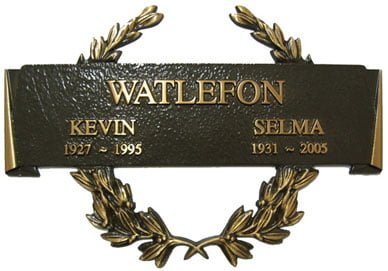
I put a lot of care into these when I make them because these are part of the grieving process. Every single one of these represents someone's loved one (or ones, often they have a both members of a couple on them). They want to know that there will be something that will last a long time. They want to know that their loved one will be remembered in the future. These plaques are symbols of love and I want to honour them.
But this week I also got to work on an order for plaques which will be put on an Indian Residential School in Kenora, along with a plaque with it's name, was a second plaque that said "In Honour of All the Children," again something that we need to remember. We tore children from their families, deprived them from their language and culture, and all in the name of Christianity (they were mostly ran by Catholic and Anglican organizations).
The work I'm doing is a form of ministry. I am involved in remembering the past, and sharing a message for the future. Hopefully in some part I am a part of people's grieving and healing processes. Even if I'm just a worker in a factory.
As a Plaque finisher, I take the plaques after they've been molded, remove excess metal via various sanders, grinders, buffers, etc. and clean them up so they can be painted.
Now this isn't the type of job I would look for, (I'm not very technically inclined), and at one point I was near quitting. But I stuck with it, and I'm glad I did.
While we make a lot of plaques for companies which are okay, I've also had the ability to do work on very worthwhile projects. Projects which in my mind are a form of ministry. I worked on the name plaque for the Jesus The Homeless statue. Which I think has a very important message about how we as Christians view the homeless.
Secondly we do A LOT of memorial plaques for cemeteries like this one I pulled off of the internet:
I put a lot of care into these when I make them because these are part of the grieving process. Every single one of these represents someone's loved one (or ones, often they have a both members of a couple on them). They want to know that there will be something that will last a long time. They want to know that their loved one will be remembered in the future. These plaques are symbols of love and I want to honour them.
But this week I also got to work on an order for plaques which will be put on an Indian Residential School in Kenora, along with a plaque with it's name, was a second plaque that said "In Honour of All the Children," again something that we need to remember. We tore children from their families, deprived them from their language and culture, and all in the name of Christianity (they were mostly ran by Catholic and Anglican organizations).
The work I'm doing is a form of ministry. I am involved in remembering the past, and sharing a message for the future. Hopefully in some part I am a part of people's grieving and healing processes. Even if I'm just a worker in a factory.
Subscribe to:
Posts (Atom)